
You have probably seen it by now.
Castor oil on the belly button. Castor oil in the eyes. Castor oil packs on the abdomen. Castor oil mixed with neem for sun protection.
Social media has rediscovered something ancient, and people are feeling the results.
At The Ayurvedic Institute, we find this beautiful. Not because the trend is new, but because it is not new at all.
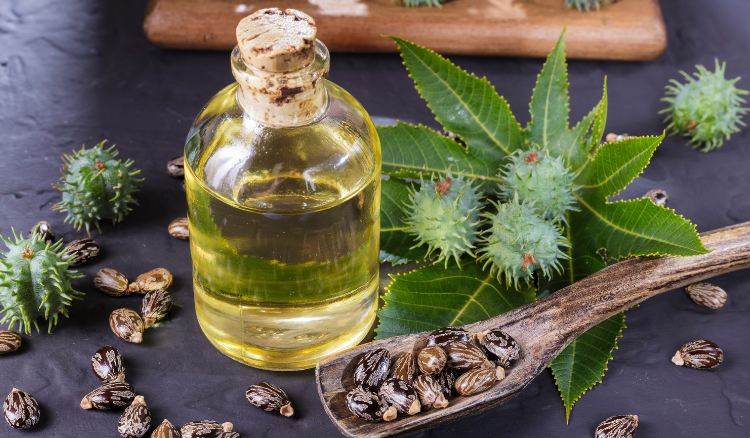
The castor plant, known in Sanskrit as Eranda, has been one of the most important medicinal plants in Ayurvedic practice for thousands of years. Its large broad leaves, which ancient texts compared to the open hand of a celestial musician, have long symbolized the healing gesture of giving.
Castor seed oil has been used classically for digestion, joint pain, eye health, liver detoxification, skin care, and colon cleansing. Dr. Vasant Lad has taught its uses across decades of clinical practice and through his published writings in Ayurveda Today.
Here is something important to understand before we go further.
Castor oil balances all three doshas. Its qualities are heavy, oily, sharp, and subtle. Its taste is sweet, pungent, and astringent. Its energy is heating when ingested and cooling when applied topically. And its post-digestive effect is sweet.
That combination is rare. And it is why castor oil can be used so many different ways for so many different conditions.
What most wellness content gets wrong, though, is treating castor oil as universal. One recommendation for everyone. In Ayurveda, that is never how it works. Your body is unique. Your dosha is unique. And the way you use castor oil should be unique too.
External Uses: Where to Start
The external uses of castor oil are accessible, well-tolerated across all doshas, and something you can begin right away. This is where most people will want to start.
For Vata Types
Vata governs movement and air in the body. When vata goes out of balance, the colon becomes dry and sluggish, the joints crack and ache, and the skin turns rough.
For dry skin, mixing castor oil with sesame oil and using it in daily self-massage creates a deeply nourishing blend. Sesame is the classic vata oil, warming and grounding. Castor oil adds penetrating power, softening the skin and moving whatever is blocking the channels.
For joint and muscle pain, a warm castor oil compress applied to the affected area is a classical recommendation. Warm the oil, soak a cloth, apply it, wrap it with a warm towel, and rest. The oil penetrates the tissue and brings relief without harshness.
For Pitta Types
Pitta governs fire in the body. When pitta elevates, the heat builds everywhere: burning eyes, inflamed skin, an overworked liver.
For burning eyes, Dr. Lad recommends placing one drop of castor oil in each eye at bedtime. The eye is one of the primary seats of pitta in the body, governed by a sub-dosha called alochaka pitta. When pitta is elevated, the eyes are often the first place the heat shows up. One drop, both eyes, at bedtime. It takes ten seconds and the results speak for themselves.
For sun protection, a blend of half castor oil and half neem oil applied to exposed skin before sun exposure serves as a natural sun blocker. Neem is cooling and anti-inflammatory. Together they create a gentle barrier that honors pitta’s sensitivity to heat.
For Kapha Types
Kapha governs earth and water in the body. When kapha goes out of balance, the body accumulates. Ama settles into the tissues. Weight gathers around the abdomen. The liver and spleen become congested.
For the belly, applying warm castor oil to the navel and abdomen in circular strokes is a practice rooted in one of Ayurveda’s deepest teachings. The nabhi, or navel, is considered the meeting place of prana and apana vayu, the two primary life forces in the body. Applying castor oil here and resting in morning sunlight for half an hour helps stimulate the liver, support the spleen, and encourage the release of stagnant kapha from the abdominal organs.
For areas of congestion or cystic tissue, warm castor oil packs applied for 20 to 30 minutes several times a week help break down what has accumulated. Castor oil packs are indicated classically for dissolving cysts, growths, and warts, and for softening corns and calluses.
Internal Use: A Word from the Tradition
Castor oil also has a rich and well-documented history of internal therapeutic use in Ayurveda.
It has been used to support digestive health across all three doshas, with specific protocols for vata-related constipation and dryness, pitta-related heat and acidity in the colon, and kapha-related sluggishness and ama accumulation.
It is also a key ingredient in Gandharva Haritaki, one of the most celebrated colon formulas in Ayurvedic medicine. This classical formula combines castor oil with roasted haritaki and warming spices, and has been used for conditions ranging from chronic constipation and hemorrhoids to sciatica and rheumatoid arthritis.
Beyond the colon, castor oil is used internally as a vehicle that carries other herbs deeper into the tissues, and as a purifying agent for the liver and spleen.
These uses are real and powerful.
And because of that power, internal use of castor oil is best explored under the guidance of a qualified Ayurvedic practitioner.
The right dose, carrier, timing, and combination vary significantly depending on your individual constitution and your current state of imbalance. What is appropriate for one person may be contraindicated for another. A practitioner can assess your full picture and create a protocol that is precise and safe for you.
Internal castor oil is contraindicated during pregnancy, in ulcerative gastrointestinal conditions, in cases of absolute constipation with impacted stool, and in acute inflammatory bowel conditions. Please always consult a practitioner before beginning any internal protocol.
The Deeper Invitation
Castor oil is trending because people are hungry for what actually works.
They are tired of synthetic solutions. They are returning to the earth, to plants, to wisdom that has been tested not for a few years but for thousands.
Ayurveda has always been here.
If you want the full picture including all three dosha external protocols, the eye remedy, the belly button practice, and an introduction to the internal uses of castor oil, download our free guide, The Ancient Ayurvedic Guide to Castor Oil, at the link below.
And if you want to go even deeper into the wisdom of Ayurveda and learn to apply it in your own life and the lives of others, we invite you to explore our programs at The Ayurvedic Institute.
This path is waiting for you.
[Download the Free Castor Oil Guide] | [Explore Our Programs]